Integrated peripherals
With the steadily declining costs and size of integrated circuits, it is now possible to include support for many peripherals on the motherboard. By combining many functions on one PCB, the physical size and total cost of the system may be reduced; highly integrated motherboards are thus especially popular in small form factor and budget computers.
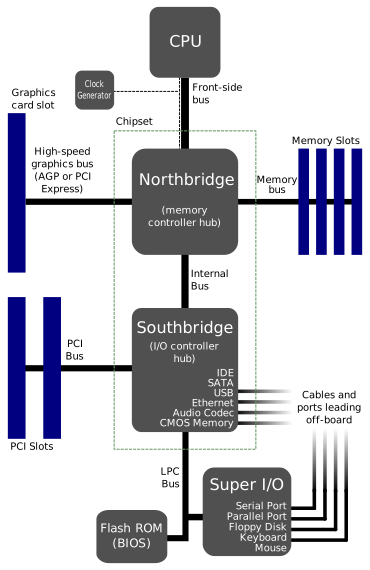
For example, the ECS RS485M-M,[6] a typical modern budget motherboard for computers based on AMD processors, has on-board support for a very large range of peripherals:
- disk controllers for a floppy disk drive, up to 2 PATA drives, and up to 6 SATA drives (including RAID 0/1 support)
- integrated graphics controller supporting 2D and 3D graphics, with VGA and TV output
- integrated sound card supporting 8-channel (7.1) audio and S/PDIF output
- Fast Ethernet network controller for 10/100 Mbit networking
- USB 2.0 controller supporting up to 12 USB ports
- IrDA controller for infrared data communication (e.g. with an IrDA-enabled cellular phone or printer)
- temperature, voltage, and fan-speed sensors that allow software to monitor the health of computer components
Peripheral card slots
A typical motherboard of 2009 will have a different number of connections depending on its standard.A standard ATX motherboard will typically have one PCI-E 16x connection for a graphics card, two conventional PCI slots for various expansion cards, and one PCI-E 1x (which will eventually supersede PCI). A standard EATX motherboard will have one PCI-E 16x connection for a graphics card, and a varying number of PCI and PCI-E 1x slots. It can sometimes also have a PCI-E 4x slot. (This varies between brands and models.)
Some motherboards have two PCI-E 16x slots, to allow more than 2 monitors without special hardware, or use a special graphics technology called SLI (for Nvidia) and Crossfire (for ATI). These allow 2 graphics cards to be linked together, to allow better performance in intensive graphical computing tasks, such as gaming and video editing.
As of 2007, virtually all motherboards come with at least four USB ports on the rear, with at least 2 connections on the board internally for wiring additional front ports that may be built into the computer's case. Ethernet is also included. This is a standard networking cable for connecting the computer to a network or a modem. A sound chip is always included on the motherboard, to allow sound output without the need for any extra components. This allows computers to be far more multimedia-based than before. Some motherboards have their graphics chip built into the motherboard rather than needing a separate card. A separate card may still be used.


Tidak ada komentar:
Posting Komentar